Last reviewed: November 2026. This guide is general information. Check any product against your own school’s needs, policies and safety guidance.
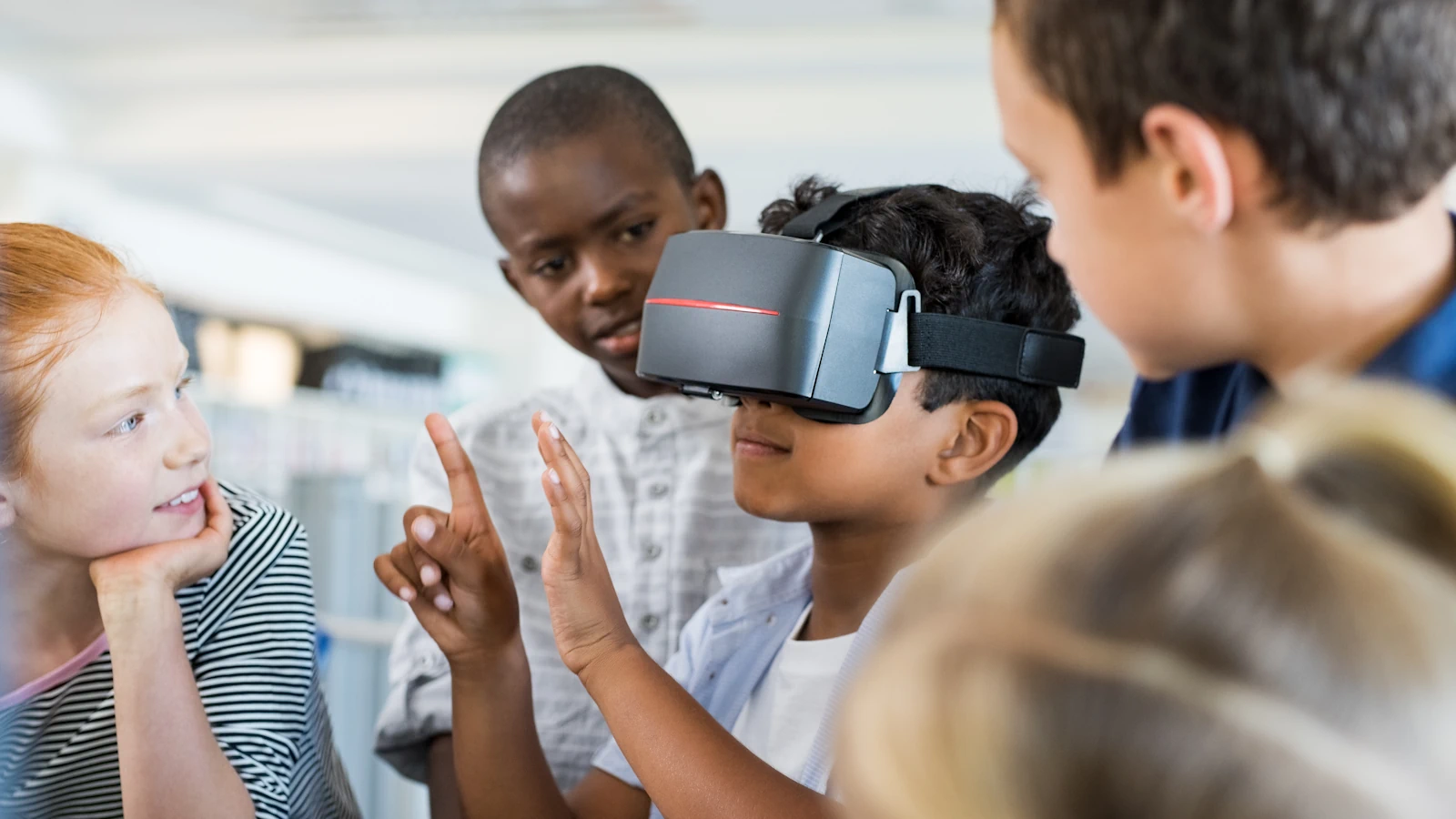
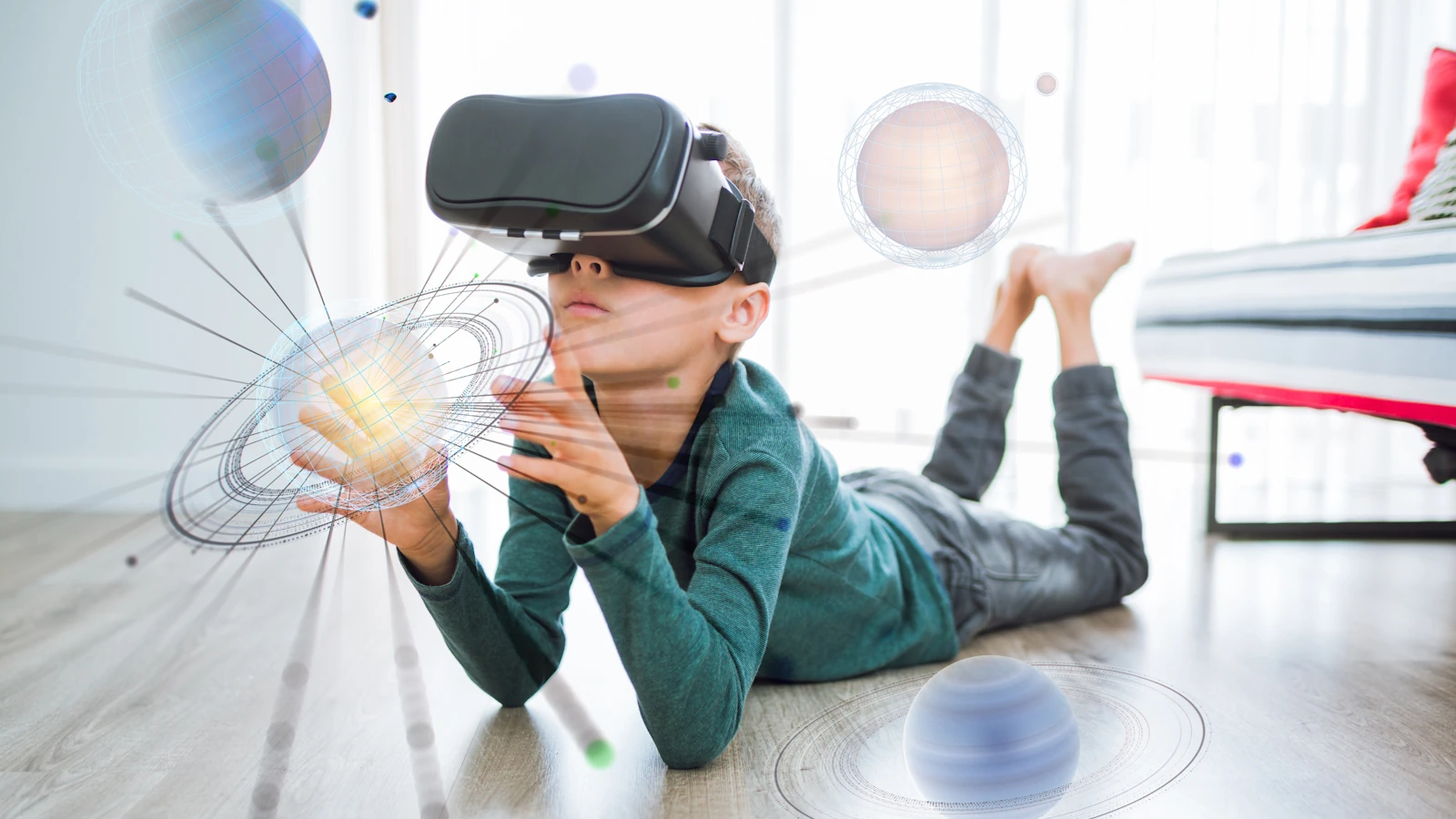
Science and math are where augmented reality (AR) and virtual reality (VR) are studied most, because both can show things students cannot otherwise see: a molecule, a force, a three-dimensional shape. The research is encouraging, with one surprise about headsets.
Key takeaways
- VR in STEM: a meta-analysis covering middle school to college found benefits across types of learning.
- Headsets are not required: in that analysis, desktop VR showed larger effects than head-mounted displays.
- AR in STEM: a review of 28 studies found most AR applications offered exploration or simulation activities.
- Geometry: a review of AR in primary mathematics reported gains in spatial skills and geometry scores.
In this guide
VR in science and engineering
A 2023 meta-analysis in the Journal of Science Education and Technology reviewed VR studies in STEM topics with learners from middle school through postsecondary education. It found positive effects across settings and across factual, conceptual and transfer learning.
Its most practical finding is that desktop VR, a 3D simulation on an ordinary screen, showed larger effects than headsets. That fits a 2019 experiment in which university students learned less from a science lab simulation in a headset than on a desktop, while reporting higher presence. For a school, this means a virtual lab on existing computers is a reasonable place to begin.
AR in science
- What AR is used for. A 2018 systematic review in Computers & Education examined 28 publications from 2010 to 2017. Most AR applications for STEM learning offered exploration or simulation activities.
- How well it works. A 2022 meta-analysis of AR in science learning noted that results differ with the discipline, the educational stage, the type of AR and the device, so one positive study does not transfer automatically to another classroom.
- In colleges. A 2022 mapping review of 45 articles on AR for STEM in higher education identified three approaches: augmenting specialized lab equipment, physical objects, and course handbooks or sheets.
Math and spatial skills
Geometry is the natural fit, because AR lets students turn a three-dimensional shape around and look inside it. A 2026 mixed-methods review of AR in primary mathematics reported moderate to very large positive effects on spatial visualization, mental rotation and spatial reasoning, and an average effect of 0.65 standard deviations on geometry test scores compared with traditional methods.
That is a single review from a smaller journal, so treat the figure as promising, not settled. The evidence is thinner for areas of math that are less visual, such as arithmetic and algebra.
For the wider picture, see virtual reality in education and augmented reality in education.
Questions to ask
- Is the concept hard to see or handle in real life? That is where AR and VR add most.
- Would a desktop simulation teach this as well as a headset?
- Does the simulation replace hands-on lab work, or prepare students for it?
Common questions
Does VR help students learn science?
A 2023 meta-analysis of STEM learning from middle school to college found positive effects across settings and types of learning. Desktop VR showed larger effects than headsets in that analysis.
Is AR useful for teaching math?
The best evidence is in geometry and spatial skills. A 2026 review of AR in primary mathematics reported an average effect of 0.65 standard deviations on geometry test scores, though this comes from a single review.
Do schools need VR headsets for virtual science labs?
Not necessarily. Research has found desktop simulations can match or beat headsets for learning, so existing computers are a reasonable starting point.
Sources
- Meta-Analysis of STEM Learning Using Virtual Reality: Benefits Across the Board. Journal of Science Education and Technology, 2023.
- Makransky G, Terkildsen TS, Mayer RE. Adding immersive virtual reality to a science lab simulation causes more presence but less learning. Learning and Instruction, 2019.
- Ibáñez M-B, Delgado-Kloos C. Augmented reality for STEM learning: A systematic review. Computers & Education, 2018.
- Xu W-W, et al. Exploring the Effectiveness and Moderators of Augmented Reality on Science Learning: a Meta-analysis. Journal of Science Education and Technology, 2022.
- Mystakidis S, Christopoulos A, Pellas N. A systematic mapping review of augmented reality applications to support STEM learning in higher education. Education and Information Technologies, 2022.
- Izzati AAT, et al. Integrating augmented reality in mathematics: A mixed-methods systematic review of spatial and geometric learning. Jurnal Inovasi Teknologi Pendidikan, 2026.